A Taste of Singapore: Food Tour Highlights
When I think of Singapore, one of the first things that comes to mind is food. With a population being a melting pot of Chinese, Malay and Indians, sprinkled with a spice of other ethnicities, you get yourself a great mix of multicultural tasty dishes.
I knew I wanted to sample a wide variety of dishes, but I also craved a deeper understanding of the local food culture. So, as I’ve done many times before, I signed up for a guided food tour with local experts. There were several companies to choose from, but when I discovered that Secret Food Tours, whom I’d toured with in Madrid a few years back, also operated in Singapore, the decision was easy.
The meeting time was fairly early, so I skipped breakfast at the hotel and met up with an empty stomach. Meeting outside the Chinatown metro station, we did not have to walk far to our first stop. We simply just turned around and entered Bee Cheng Hiang. The name of the shop means three things: good to look at, taste awesome, smell wonderful. I would say all three were quite describing. The smell of the bakkwa being grilled in the back of the shop was mouthwatering, and luckily our first taste was quickly being served.


There are several types of the bakkwa, and we got to try the “Golden coin” that had a circular shape. It tasted a bit sweeter than I expected, but I could certainly have cashed in a few more, they were delicious! In earlier days, when most people were poorer, the bakkwa was mainly eaten at special occasions, and it is still a very important part of the Chinese New Year tradition. Our guide Jag walked us through the shop, explaining the many other delights they also offered.


As we strolled towards the next stop, Jag shared insights about the area, both in an historic and present aspect. We also stopped at a large, beautiful mural of a traditional house divided into several rooms.
Our second food and drink stop was an old and atmospheric cafe. Since I do not drink coffee (and not too often tea either), I was happy to hear it was a different option, a combination of the two, in an iced version. I mainly drink hot drinks to keep warm, so the cold version was a better pick in general, especially in the heat.
The second floor was cozy and inviting, with the walls telling different stories. Both in the sense of histories being in the walls, but also with displays of historic artifacts.
Along with the drink, we also got served toast with butter and Kaya – a sweet jam made by coconut milk, egg and sugar, and sometimes added pandan leaves for fragrance.


This led us to our next stop: pandan cake. I’ll admit I was a bit sceptical about the spongy, minty-green dessert, but I was pleasantly surprised.


The tour was not all about food. Between the stops and during the sit downs, we also talked about life, society, and traditions, giving us a taste of the local life as well.
I am very familiar with the street food vendors in Thailand after living in Bangkok many years ago. Scattered across corners and alleys in a buzzing, delightful chaos. Singapore had a similar scene until the 1960s, when the government began relocating vendors into hawker centres to improve organization and hygiene.
Today, hawker centres are a vital part of Singaporean culture, reflecting its multicultural roots. Many stalls have long traditions and are often passed down from generation to generation. You will find all kinds of food, and some of the stalls even have a Michelin Star.
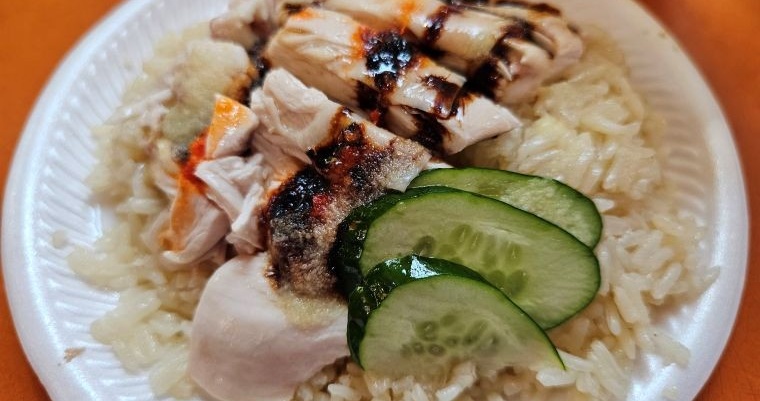
At Maxwell Food Centre, rows of food stalls awaited us. With so many options, it was a relief to have a guide who knew exactly what to try and where to order. And we were definitely in for a treat! Starting off with chicken rice served with chili and garlic sauce, sweet soy sauce and ginger on the side. The rice was so juicy and tasty, and we learned the secret was to cook it in the chicken broth. To drink we had a perfectly sour lime juice from another vendor.


To sweeten things up, our next dish was a bowl-shaped pancake with a thin crust and fluffy centre. It was served with dried coconut and orange coloured sugar on the side. The dish is originally from the south of India, and is popular as dessert. While we thought that might mark the end of the tour, the food kept coming.

Next up was friend banana and fried chempedak. I had never heard of chempedak before, but it is a fruit in the jackfruit family. I must admit fried thick batter is not my favourite, but I am always up for trying something new, although I would probably not head over to buy another batch anytime soon.

As Jag headed out on a quest to get some carrot cake, we were sure we were still on the desert lane. But we soon learned that carrot cake, despite the name, was not carrot, nor cake. It is actually a long white radish, that can look like a white carrot, hence the confusion of the name. The radish is grated and mixed with rice flour, and steamed to get a firm texture. This is again chopped up and mixed with egg and seasoning. To get the black version, they simply just add the sweet soy sauce. As we were on a food tour, Jag of course got us both to taste.

By this point, we were seriously full. But we had one more sweet treat: shaved ice with chendol – a green jelly made from pandan leaf – and palm sugar syrup for extra sweetness.

This would have marked the end of the tour, but Jag had another treat for us. As we had been walking along the streets earlier, we had passed several places selling durian. Despite the fact that I have travelled extensively in Asia, and even lived in Bangkok, I had never tasted it. Nor had my new fellow food tour mates from Australia. While we struggled to finish our meal, Jag ran out, and came back with some creamy, smelly durian for us. If you have smelled durian, you know it is very distinct, but it was not as intense as I thought it would be. In fact, durian is banned in many places due to its strong odour. When I checked into my hotel, I even had to sign a waiver agreeing to pay a fine if I brought durian into my room! The others weren’t exactly fans, but I’m glad I finally got to taste it – and I probably will again. In a designated area.


If you’re curious about Singapore’s food scene and enjoy learning while you eat, joining the Secret Food Tour Singapore is a great way to start. It’s a fun and easy way to explore local flavours, hear the stories behind the dishes, and discover spots you might not find on your own. I really enjoyed the experience—and if you go with an open mind and an empty stomach, chances are you will too.
Want to see what other cities I have eaten my way through? Check out these food tours.